


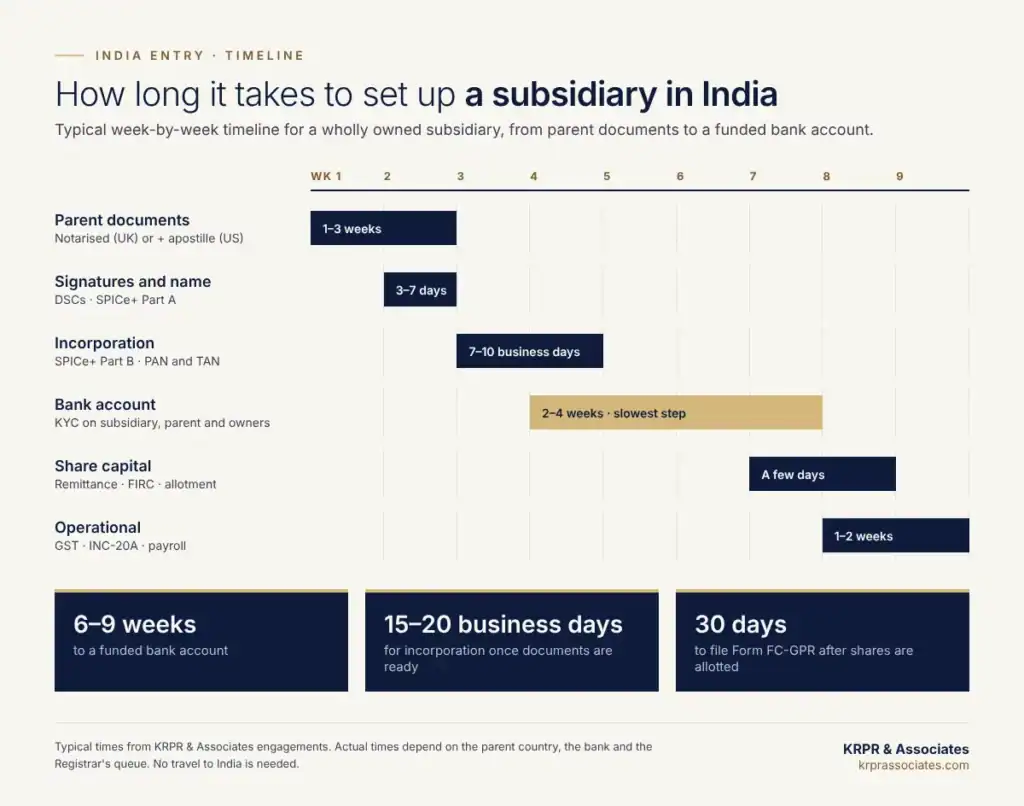
Setting up a subsidiary in India takes 6 to 9 weeks from the first notary appointment to a funded bank account. Incorporation itself takes 15 to 20 business days once the parent’s documents are authenticated. Parents from Commonwealth countries, such as the UK, are often faster because their documents need notarisation only. No one needs to travel to India. The bank account is the step most often underestimated.
| Incorporation (MCA) | 15–20 business days after documents are ready |
|---|---|
| Ready to operate | 6–9 weeks in total, ending with a funded bank account |
| Slowest step | Corporate bank account: 2–4 weeks |
| Parent documents | Notarisation only (Commonwealth), plus apostille (other Hague countries) or consular authentication (others) |
| Travel to India | Not required |
| First hard deadline | Form FC-GPR within 30 days of share allotment |
Week-by-week: the subsidiary setup timeline
A foreign-owned Indian subsidiary moves through six stages over 6 to 9 weeks. Two stages run on the parent’s clock: document authentication and the capital remittance. The rest run on Indian timelines.
| Week | Stage | What happens | Typical time |
|---|---|---|---|
| 1–2 | Parent documents | Board resolution, certificate of incorporation and address proof are notarised (UK) or notarised and apostilled (US). | 1–3 weeks |
| 2 | Signatures and name | Directors get Digital Signature Certificates. The company name is reserved through SPICe+ Part A. | 3–7 business days |
| 3–4 | Incorporation | SPICe+ Part B is filed with the e-MOA and e-AOA. The Certificate of Incorporation issues with PAN and TAN. | 7–10 business days |
| 4–7 | Bank account | The bank runs KYC on the subsidiary, the parent and the parent’s beneficial owners. | 2–4 weeks |
| 7–8 | Share capital | The parent remits capital. The bank issues the FIRC and KYC report. Shares are allotted. | A few days |
| 8–9 | Operational | GST registration, Form INC-20A and payroll setup are completed. | 1–2 weeks |

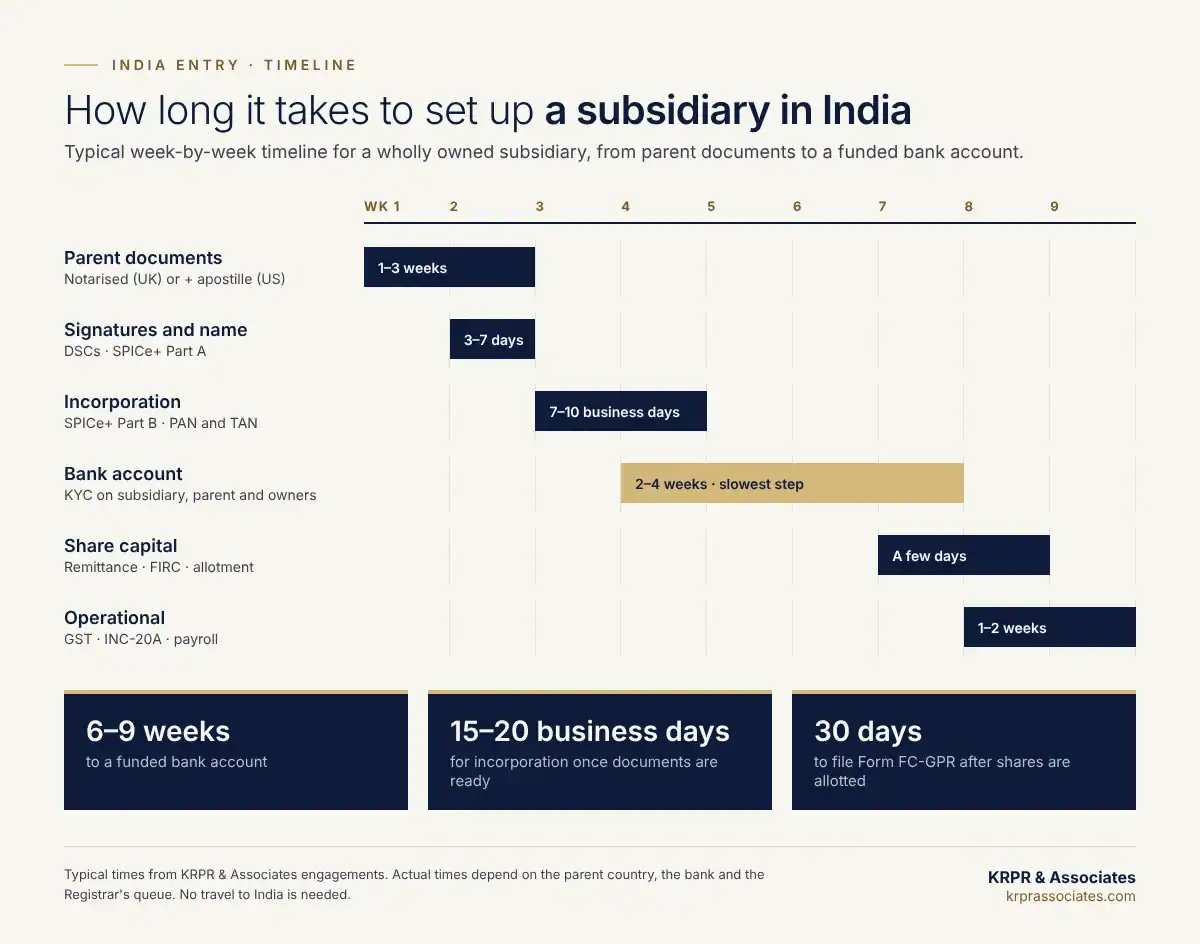
Form FC-GPR is filed after this, within 30 days of share allotment. It does not delay operations, but it is a hard deadline.
How long does incorporation take in India?
Incorporating an Indian private limited company takes 15 to 20 business days once the parent’s documents are authenticated. The Ministry of Corporate Affairs handles every step online through the SPICe+ form.
Each director who signs the incorporation forms needs a Digital Signature Certificate. Directors outside India complete identity and video verification remotely.
The Ministry of Corporate Affairs approves or rejects up to two proposed names. An approved name stays reserved for 20 days. A name close to an existing Indian company or trade mark is rejected.
The filing covers the e-MOA, e-AOA and AGILE-PRO-S. The Certificate of Incorporation issues with the company’s PAN and TAN. EPFO and ESIC employer registrations are allotted through the same filing.
Does the parent company’s country change the timeline?
Yes. The parent’s country decides how its documents must be authenticated, and that can add one to three weeks. Rule 13(5) of the Companies (Incorporation) Rules, 2014 sets three routes. Everything after authentication takes the same time for every parent.
| Parent country | Requirement for the MCA filing | Rule 13(5) | Time to plan for |
|---|---|---|---|
| United Kingdom, Singapore, Australia, Canada and other Commonwealth countries | Notarisation only | Clause (a) | Days |
| United States, Germany, France, Netherlands, Japan and other Hague Apostille Convention countries | Notarisation, then apostille | Clause (b) | Days to several weeks, depending on the issuing office |
| Countries in neither group | Notarisation, then authentication by an Indian embassy or consulate | Clause (c) | Often the longest route — confirm with the consulate first |
In the United States, the apostille comes from the Secretary of State of the state where the document was notarised. Processing times differ by state, so check the state office before booking. Country-specific guides: United States, United Kingdom, Germany, Singapore, Australia.
An Indian bank may still ask a Commonwealth parent for apostilled documents, even though the MCA filing does not need them. Ask the bank first. In the UK, the FCDO’s standard apostille service takes up to 25 working days. Its e-Apostille takes up to 2 working days, and registered businesses can use a next-day service.
Why does the bank account take the longest?
A corporate bank account for a foreign-owned Indian company takes 2 to 4 weeks because the bank checks three parties. It verifies the new subsidiary, the foreign parent and every ultimate beneficial owner of the parent.
Delays come from ownership chains through funds or holding companies, names that differ across documents, and board resolutions that name the wrong signatories. Start the bank’s paperwork the day the Certificate of Incorporation issues. Do not wait until the capital is ready to send.
How can you shorten the timeline?
Most time is saved before anything is filed in India. These steps take the setup toward 6 weeks rather than 9.
- Book the notary in week one, before the company name is final.
- Shortlist two names. Check them against the MCA register and the Indian trade mark registry.
- Collect each director’s passport and address proof. Address proof must be no older than two months.
- Confirm the resident director early. That person must stay in India for at least 182 days in the financial year (Companies Act, 2013, section 149(3)).
- Prepare an ownership chart down to the ultimate beneficial owners for the bank.
- Ask the remitting bank for the FIRC and KYC report at the time of remittance.
Deadlines that start after incorporation
Five statutory deadlines start once the subsidiary exists. Each one runs from a fixed date, so diarise them on the day of incorporation.
| Obligation | Deadline | Law |
|---|---|---|
| First board meeting | Within 30 days of incorporation | Companies Act, 2013, s.173(1) |
| First statutory auditor appointed by the board | Within 30 days of incorporation | Companies Act, 2013, s.139(6) |
| Shares allotted to the parent | Within 60 days of receiving the money | FEMA (Non-Debt Instruments) Rules, 2019 |
| Form FC-GPR to the Reserve Bank of India | Within 30 days of allotment | FEMA, RBI FIRMS portal |
| Form INC-20A, commencement of business | Within 180 days of incorporation | Companies Act, 2013, s.10A |
A late Form FC-GPR can be regularised with the RBI’s Late Submission Fee: ₹7,500 plus 0.025% of the amount for each year of delay. See FEMA & FDI compliance for the reporting process.
Mistakes that add weeks
1. Apostilling documents that only need notarisation
Finance teams in the UK, Singapore and Australia often apostille every document by default. For the MCA filing, notarisation is enough for Commonwealth parents under Rule 13(5)(a). The extra apostille can add weeks on the standard FCDO service. Check what the bank needs before ordering it.
2. Starting the bank account after the capital is ready
Some parents wait until funds are approved before contacting a bank. The bank’s KYC then becomes the critical path. Start the bank paperwork the week the Certificate of Incorporation issues.
3. Using old address proof
Director address proof older than two months gets rejected. The filing then restarts with fresh documents. Collect recent utility bills or bank statements in week one.
4. Promising start dates to the first hires too early
A subsidiary cannot pay salaries until its bank account is open and funded. Offer letters dated from incorporation leave new hires unpaid for weeks. Set start dates after the expected account opening, or use an employer of record as a planned bridge.
5. Treating the Certificate of Incorporation as the finish line
Form INC-20A must be filed before the company commences business or borrows. It needs proof that the parent’s subscription money has arrived. Diarise it on the day of incorporation.
When you need professional help
A finance team can gather the parent’s documents, choose names and set the share capital. The SPICe+ portal itself is usable.
Three steps are worth professional support, because errors there are costly or slow to fix:
- Form FC-GPR and the remittance paperwork
- The bank’s beneficial-ownership review
- The intercompany agreement, which must exist before the first invoice
For the full process, read how to set up a subsidiary in India.
Frequently asked questions
How long does it take to register a company in India as a foreign company?
Registering a foreign-owned private limited company in India takes 15 to 20 business days once the parent’s documents are authenticated. Allow 6 to 9 weeks in total to reach a funded bank account. Document authentication in the parent country and bank account opening in India take the most time.
Can an Indian subsidiary be set up in two weeks?
Not from a standing start. Incorporation alone takes 15 to 20 business days after documents are ready. A company that already holds authenticated documents and approved directors can be incorporated in about three weeks. Opening and funding the bank account adds another 2 to 4 weeks.
Do directors need to travel to India to set up a subsidiary?
No. Digital Signature Certificates, Director Identification Numbers, the SPICe+ filing and bank account opening are completed remotely. Authenticated original documents are couriered to India. Separately, one director must stay in India for at least 182 days in the financial year, which a resident director satisfies.
Do foreign company documents need an apostille for an Indian subsidiary?
It depends on the parent’s country. Commonwealth countries such as the UK, Singapore and Australia need notarisation only. Other Hague Convention countries, including the US and Germany, need notarisation plus an apostille. Other countries need Indian consular authentication. Rule 13(5) of the Companies (Incorporation) Rules, 2014 sets these routes.
How long does a bank account take for a foreign-owned Indian company?
Plan for 2 to 4 weeks. The bank runs know-your-customer checks on the subsidiary, the foreign parent and the parent’s ultimate beneficial owners. Long ownership chains and inconsistent names across documents cause most delays. Start the bank paperwork the day the Certificate of Incorporation issues.
How long does GST registration take for a new Indian subsidiary?
Under Rule 9 of the CGST Rules, 2017, the GST officer acts within seven working days of the application. Where Aadhaar authentication is not completed, or the officer orders physical verification of the premises, the limit extends to thirty days. Apply once the registered office and bank details are ready.
When can a new Indian subsidiary hire and pay employees?
The subsidiary can sign employment contracts once it is incorporated. It can pay salaries only after its bank account is open and the parent’s share capital has arrived. In practice, that is 6 to 9 weeks from the start of setup. An employer of record can bridge earlier hires.
How long is a reserved company name valid in India?
A name approved through SPICe+ Part A is reserved for 20 days for a new company. The incorporation filing must be made within that period, or the name lapses. Prepare the incorporation documents while the name application is pending to avoid losing the reservation.
What is the deadline for Form FC-GPR after setting up a subsidiary?
Form FC-GPR is due on the Reserve Bank of India’s FIRMS portal within 30 days of allotting shares to the foreign parent. Shares must be allotted within 60 days of receiving the money. A late filing attracts a Late Submission Fee of ₹7,500 plus 0.025% of the amount per year of delay.
Plan your India setup timeline
A senior consultation maps your timeline for your parent country, the documents to start in week one, and the post-incorporation deadlines. You receive a written itemised quote for incorporation and first-year compliance.
Request a senior consultation- Source: Ministry of Corporate Affairs — Companies (Incorporation) Rules, 2014, Rule 13(5); SPICe+
- Source: India Code — Companies Act, 2013, ss.10A, 139(6), 149(3), 173(1)
- Source: CBIC — CGST Rules, 2017, Rule 9
- Source: Reserve Bank of India — FIRMS portal, Form FC-GPR
- Source: GOV.UK — Get your document legalised


Rohit Lohade is a Chartered Accountant and India entry specialist at KRPR & Associates. With 15+ years of experience, he has assisted 250+ international companies — including global brands — incorporate and operate in India. He currently serves as Resident Director for multiple foreign-owned Indian subsidiaries.