
Last Updated on 4 days ago by CA Rohit Lohade
No. To register an Indian company, documents signed by people who live in the UK need notarisation by a UK notary public only. Rule 13(5)(a) of India’s Companies (Incorporation) Rules, 2014 sets this route for all Commonwealth countries. An FCDO apostille is needed only for signers in Hague Convention countries outside the Commonwealth, such as the US. Some Indian banks may still ask for one, so check first.
| Rule that applies | Companies (Incorporation) Rules, 2014, Rule 13(5)(a) |
|---|---|
| What a UK signer needs | Notarisation by a UK notary public |
| Apostille for the company registration | Not required for signers living in the UK |
| What decides the route | The country where the signer lives, not their passport |
| FCDO apostille, if you still want one | £45 per document (standard) or £35 (e-Apostille) |
| FCDO standard processing time | Up to 25 working days, plus postage |
| Indian consulate attestation | Not needed for the company registration |
Do UK company documents need an apostille for India?
UK company documents do not need an apostille to register a company in India. They need notarisation by a UK notary public, which covers the signatures, addresses and identity proofs of people who live in the UK.
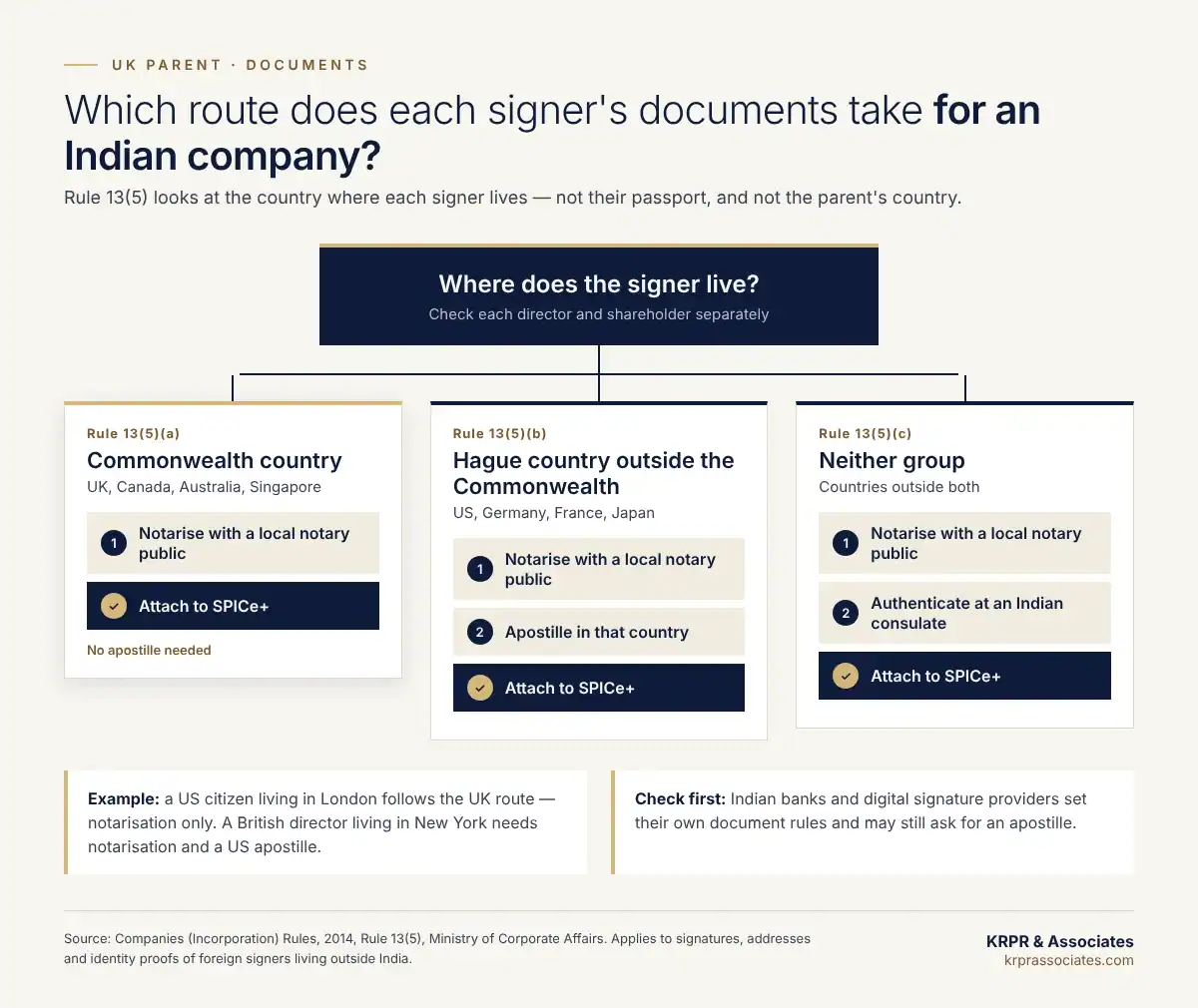
The rule sits in the Companies (Incorporation) Rules, 2014, made under India’s Companies Act, 2013. Rule 13(5) sets three routes for foreign nationals who live outside India, based on the country where they live.
The UK is part of the Commonwealth, so Rule 13(5)(a) applies and a notary’s attestation is enough. The Registrar of Companies (the government office that registers companies) receives these papers through SPICe+ (the online company registration form).
Many guides tell UK parents to notarise and then apostille every document. That advice applies the US route to the UK, adding cost and up to 25 working days.
What does Rule 13(5) say for each type of country?
Rule 13(5) gives one route for Commonwealth countries, one for Hague Convention countries and one for all others. The Hague Convention is the 1961 treaty that created the apostille, and India and the UK are both parties to it.
| Where the signer lives | What the rule needs | Examples |
|---|---|---|
| Commonwealth country — Rule 13(5)(a) | Notarisation by a notary public of that country | UK, Canada, Australia, Singapore |
| Hague Convention country outside the Commonwealth — Rule 13(5)(b) | Notarisation, then an apostille under the Hague Convention | US, Germany, France, Japan |
| Neither — Rule 13(5)(c) | Notarisation, then authentication by an Indian diplomatic or consular officer | Countries outside both groups |
The Commonwealth route comes first in the rule, so a Commonwealth country that is also a Hague member, like the UK, follows the notarisation-only route.
Does the route depend on nationality or where the signer lives?
The route depends on where the signer lives, because Rule 13(5) speaks of a foreign national “residing” in a country. Nationality and the parent company’s country do not decide it.
- A US citizen who lives in London signs in the UK, so notarisation by a UK notary is enough.
- A British director who lives in New York signs in the US, so that director needs notarisation and a US apostille. Our guide explains the US notarisation and apostille route.
- A UK parent with directors in two countries may need two routes in one filing.
Work out the route for each signer separately before anyone books a notary. A US-based signer can follow our guide to registering a US subsidiary in India.
Which UK documents does the Indian company registration need?
The registration needs identity papers for each person and corporate papers for the UK parent. Rule 12(2) lists what a corporate shareholder must provide, including a copy of its certificate of incorporation and a board resolution.
| Document | Who provides it | UK step |
|---|---|---|
| Passport of each director and individual shareholder | The person | Copy certified by a UK notary |
| Recent address proof, such as a bank statement | The person | Copy certified by a UK notary |
| Certificate of incorporation of the UK parent | Companies House | Certified copy, then notarised |
| Board resolution approving the investment and naming the signatory | UK parent board | Signed, then notarised |
| Signed memorandum and articles of the Indian company | Authorised signatory | Signature attested by a UK notary |
The board resolution must authorise the share subscription and state the number of shares. It must name the signer, who must be a director, officer or employee of the UK parent.
Companies House sells certified copies of company documents, and standard dispatch costs £22 per document and aims to leave within 10 working days. Express costs £65 and goes the same day if ordered before 11am.
Our full list of documents required to register a subsidiary company covers every parent country.
When does a UK parent still need an apostille?
A UK parent still needs an apostille when a signer lives outside the Commonwealth, or when another party asks for one. The company registration rule is only one set of rules.
A signer lives in a Hague country outside the Commonwealth
Rule 13(5)(b) then applies to that signer, so their documents need notarisation and an apostille from the country where they live.
The Indian bank asks for it
Indian banks run their own KYC checks (identity checks on customers) on the foreign parent. Some banks set stricter document rules than the Registrar, so ask the bank in writing before your notary appointment.
The certificate provider asks for it
Each director needs a DSC (a digital signature certificate used to sign Indian filings). Licensed providers set their own document rules for foreign applicants, so confirm their list before you prepare the pack.
The document will be used for something else in India
The Consulate General of India in Birmingham says UK public documents apostilled in the UK are recognised in India without further attestation. A power of attorney for use in India is a common example.
Ask every party once, in writing. Collect the bank’s and the certificate provider’s document lists before the notary appointment, so that one visit covers every need.
How long and how much does each UK route cost?
Notarisation alone needs one notary appointment, while an FCDO apostille adds a fee per document and between one and 25 working days. The FCDO Legalisation Office issues all UK apostilles from its own online service.
| Step | Fee per document | Time |
|---|---|---|
| Notarisation by a UK notary public | Set by each notary; ask for a quote | Depends on the notary |
| FCDO apostille, standard (paper) | £45 plus postage | Usually up to 25 working days |
| FCDO apostille, Next-Day (registered businesses) | £40 | Next working day |
| FCDO e-Apostille | £35 | Up to 2 working days |
| FCDO Restricted Urgent (pre-approved by email) | £100 | Same day |
The FCDO apostilles a copy only after a UK notary or solicitor certifies it. So an apostille never replaces the notary; it is always an extra step on top.
What happens after the UK documents are ready?
After the UK documents are ready, they are scanned and attached to SPICe+, and the directors sign the form with their DSCs. The Registrar then reviews it and issues the certificate of incorporation.
Keep the original notarised papers, because the bank may want to see them when it opens the account. Our guide on how long it takes to set up a subsidiary in India covers each later stage.
For the full process from start to finish, see how to set up a subsidiary in India. UK parents can also read our UK subsidiary guide.
Mistakes UK parents make with documents for India
Paying for apostilles the Registrar does not need
Many UK parents apostille every page because a guide said so, but the Registrar needs notarisation only for UK signers. Ask the bank first, then apostille only what it asks for.
Using a solicitor instead of a notary public
A solicitor’s certified copy is enough for the FCDO, but Rule 13(5)(a) names a notary public. Use a notary for the documents filed with the Registrar.
Choosing the route by the parent’s country
Teams often assume a UK parent means a UK route for everyone, but the rule looks at where each signer lives. Check each director’s country of residence before the pack is prepared.
Notarising before the Indian drafts are final
The Indian memorandum and articles often change during review, and a change after signing can mean a second notary visit. Agree the final drafts first, then sign once.
Names that differ across documents
A middle name on the passport but not on the bank statement can cause a query, because the Registrar compares names across every document. Check spellings match before the notary appointment.
When you need professional help
A UK parent with all signers in the UK can often prepare the pack with a notary alone. Get help when signers live in more than one country, when the bank’s rules are unclear or the parent is part of a larger group.
A practitioner can give you one document list that fits the Registrar, the bank and the certificate provider, which avoids repeat notary visits and resubmitted forms.
Frequently asked questions
Is an apostille required for UK documents used in India?
For registering an Indian company, an apostille is not required for documents signed by people living in the UK. Rule 13(5)(a) of the Companies (Incorporation) Rules, 2014 needs notarisation by a UK notary public only. Other Indian bodies, such as banks, may set their own rules, so check with them first.
Does India accept apostilled documents from the UK?
Yes. India and the UK are both parties to the 1961 Hague Apostille Convention. The Consulate General of India in Birmingham says UK documents apostilled in the UK are recognised in India. No further attestation by the Indian High Commission or a consulate is needed for those documents.
How much does an apostille cost in the UK?
The FCDO Legalisation Office charges £45 per document for the standard paper service, plus postage. Registered businesses can use the Next-Day service at £40 per document. The e-Apostille costs £35. The Restricted Urgent same-day service costs £100 and needs approval by email first.
How long does a UK apostille take?
The FCDO standard paper service usually takes up to 25 working days, plus postage time. The e-Apostille takes up to 2 working days. Registered businesses can use the Next-Day service. A same-day Restricted Urgent service exists but must be approved by email before you apply.
What is the difference between notarisation and an apostille?
Notarisation is when a notary public confirms a signature, identity or true copy. An apostille is a certificate from a government office that confirms the notary’s or official’s signature. In the UK, the FCDO issues apostilles. An apostille is always an extra step on top of notarisation.
Can a UK solicitor certify documents for an Indian company registration?
A UK solicitor can certify copies for the FCDO apostille service. For the Indian company registration, Rule 13(5)(a) names a notary public of the Commonwealth country. Use a UK notary public for documents filed with India’s Registrar of Companies to avoid a query or resubmission.
Do directors need to travel to India to register a company?
No. Directors and shareholders living in the UK can sign in the UK before a UK notary public. The scanned documents are attached to SPICe+, India’s online company registration form. Each director signs the form with a digital signature certificate. No one needs to visit India for this step.
Does a British director living in the US need an apostille?
Yes. Rule 13(5) looks at the country where the signer lives, not their passport. A British director living in the US falls under Rule 13(5)(b). That director’s documents need notarisation by a US notary and then a US apostille before they are filed in India.
Do UK documents need attestation by the Indian High Commission?
No. For the Indian company registration, UK signers need notarisation only. Consular attestation is the route under Rule 13(5)(c) for countries outside the Commonwealth and the Hague Convention. The UK is in both groups, so the Indian High Commission does not need to attest these documents.
Get your UK document pack right the first time
A senior consultation checks where each signer lives, what the Registrar and your bank need, and the order to prepare documents in. You receive a written itemised quote for incorporation and first-year compliance.
Request a senior consultation- Source: Ministry of Corporate Affairs — Companies (Incorporation) Rules, 2014, Rules 12(2) and 13(5)
- Source: GOV.UK — Get your document legalised (FCDO Legalisation Office fees and times)
- Source: Companies House — Find and update company information (certified copies)
- Source: HCCH — Status table, Apostille Convention of 5 October 1961
- Source: Consulate General of India, Birmingham — Attestation of documents

Rohit Lohade is a Chartered Accountant and India entry specialist at KRPR & Associates. With 15+ years of experience, he has assisted 250+ international companies — including global brands — incorporate and operate in India. He currently serves as Resident Director for multiple foreign-owned Indian subsidiaries.